
Blog
Jewelry Appraisal Insurance Value vs Resale Value: Why the Numbers Never Match
A jewelry appraisal written for insurance and a dealer's offer to buy the same piece measure two different things, not a mistake. This guide walks through the retail markup and liquidity discount math that explains why a $5,000 insurance value might only fetch $1,200 to $1,800 on resale.
Most people who get a jewelry appraisal only see one number, and they assume it means one thing: what the piece is worth. Then they try to sell the item, get an offer from a dealer or pawn shop for a fraction of the appraised figure, and conclude either that they got lowballed or that the appraisal was wrong. Neither is usually true. The appraisal and the offer are answering two completely different questions, and understanding the math behind each one clears up the confusion fast.
Insurance Value and Resale Value Answer Different Questions
An insurance appraisal estimates what it would cost to replace your jewelry with something of like kind and quality at retail, today. A resale or fair market value appraisal estimates what a willing buyer and willing seller would actually agree to in an open market, with neither side under pressure to act. These are not two attempts at the same number. They are two different valuation premises, and our jewelry appraisal services are built around identifying which one a client actually needs before the engagement starts.
The IRS draws this line explicitly. IRS Publication 561 notes that an insurance appraisal reflects the replacement cost at the time it was obtained, not what a willing buyer and seller would pay for the item on a given valuation date. That single sentence explains most of the confusion consumers run into when they compare an old insurance appraisal to a current buyer's offer.
The American Society of Appraisers draws the same distinction in its jewelry guidance: insurers typically want a description of the item paired with an opinion of its current replacement value, while assignments involving donations, probate, marital dissolution, or gift tax call for a fair market value opinion instead. Same ring, same stone, two legitimate numbers, because the intended use is different.
Why the Insurance Number Runs High: Retail Markup
An insurance replacement figure is built to fund buying a comparable new piece at a retail jeweler, not to predict what you could sell your current piece for. Retail pricing bakes in a lot of cost that has nothing to do with the raw materials:
- Wholesale acquisition cost of the diamond or gemstone and the precious metal
- Labor, casting, and setting work to manufacture or assemble the piece
- Retail overhead: store lease, staff, marketing, and insurance for the jeweler's own inventory
- Service add-ons like warranties, sizing, cleaning, and appraisal documentation bundled into the sale
- Profit margin, which in fine jewelry retail commonly runs well above a simple cost-plus markup
All of that is legitimate. If your ring is lost or stolen, you need enough money to walk into a store and buy an equivalent piece, overhead and all. That is exactly what a replacement value appraisal is designed to fund.
Why the Resale Offer Runs Low: The Liquidity Discount
A dealer, pawn shop, or auction house evaluating your jewelry for purchase is solving a different problem. They are not buying something to wear. They are buying inventory they need to resell, and every dollar of risk and delay in that process gets priced into their offer:
- Resale uncertainty: the buyer does not know how long the piece will sit before it sells, and that holding cost gets discounted up front.
- Handling and marketing costs: testing, cleaning, photography, listing fees, and in some channels sales commissions.
- Mounting devaluation: a secondhand setting often has little independent resale value compared to the loose stone or scrap metal inside it, especially for dated or highly customized designs.
- Required margin: the buyer still needs room to profit when they eventually resell, so they cannot offer anywhere close to what they expect to receive later.
- Weaker demand for specific designs: fashion, brand, and style all affect what a secondary-market buyer believes they can move the piece for.
This combination is often called a liquidity discount: the price concession a seller accepts in exchange for a fast, certain transaction instead of waiting to find a retail buyer willing to pay full value.
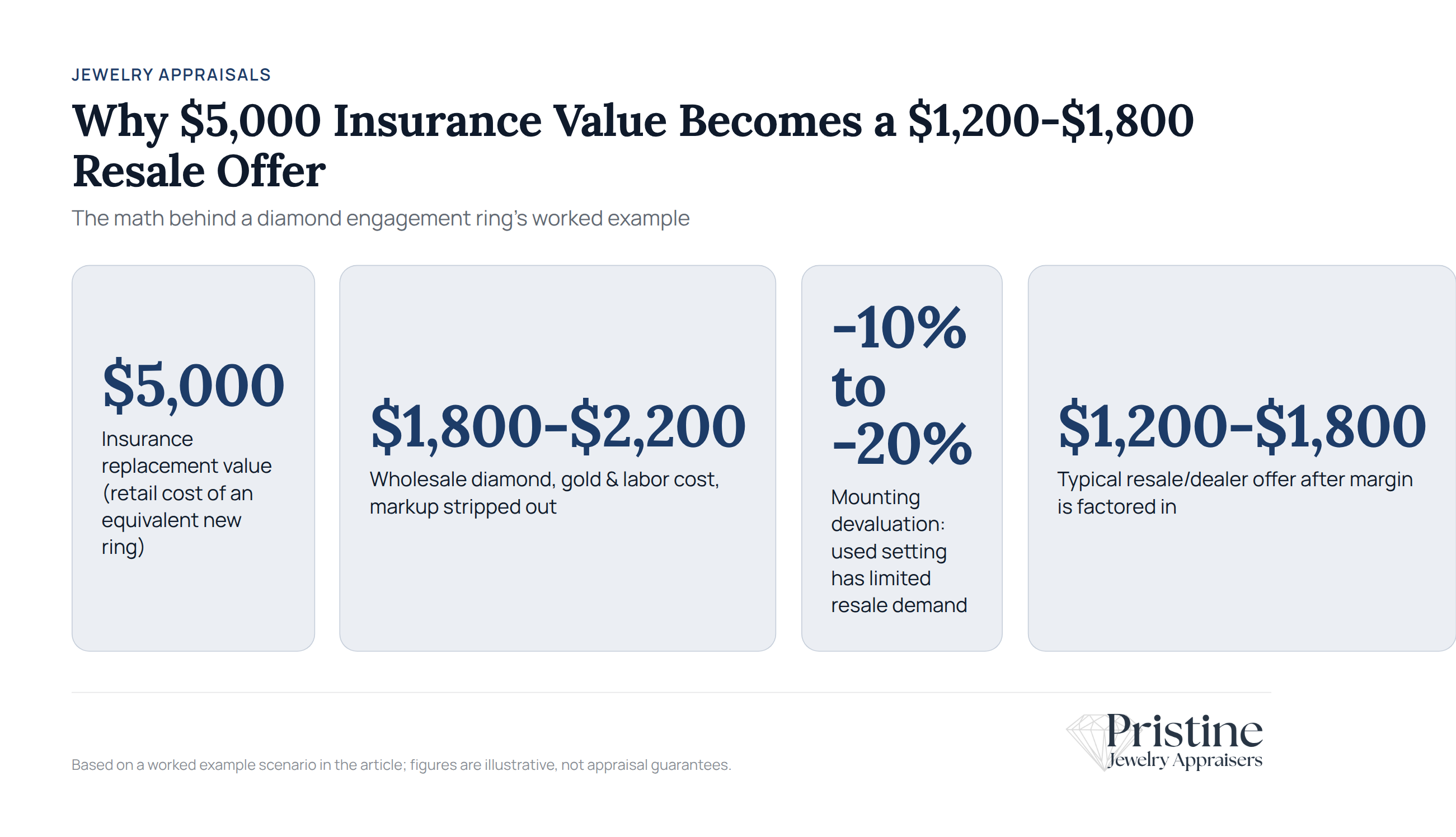
A Worked Example: $5,000 Insurance Value, $1,200 to $1,800 Resale Offer
Here is how the math plays out on a common scenario: a diamond engagement ring appraised for $5,000 in replacement value.
| Step | Amount | What it reflects |
|---|---|---|
| Insurance replacement value | $5,000 | Cost to buy an equivalent new ring at retail today |
| Wholesale material and labor cost | $1,800 - $2,200 | Diamond, gold, and manufacturing cost with retail markup and overhead stripped out |
| Mounting devaluation | Minus an additional 10% - 20% | Secondhand setting has limited independent resale demand |
| Dealer's required margin | Minus 20% - 30% more | Buyer needs room to profit on eventual resale |
| Typical resale or dealer offer | $1,200 - $1,800 | What a secondary-market buyer can profitably pay today |
Example: If your ring carries a $5,000 insurance appraisal and its diamond and gold would cost roughly $2,000 to source and fabricate at wholesale, a dealer buying the finished ring still has to account for the fact that the mounting is worth less used than new, that they are not certain how fast it will resell, and that they need margin when it does. Stack those discounts together and a $1,200 to $1,800 offer is not a lowball. It is the arithmetic of a different market.
This Isn't an Error, It's a Different Intended Use
Key takeaway: a mismatch between an insurance appraisal and a buyer's offer almost never means the appraisal was wrong. It usually means the two figures were never supposed to match in the first place.
An appraisal is only meaningful when it states its purpose, its definition of value, and its effective date. An insurance assignment calls for replacement value. A sale, donation, estate, or divorce matter calls for fair market value instead, since that standard asks what an actual buyer and seller would agree to in the open market, with neither side forced to act. IRS guidance on charitable contributions requires exactly this kind of market-based valuation, prepared in accordance with recognized appraisal standards, when jewelry is donated and a qualified appraisal is required. The federal definition of fair market value, the price between a willing buyer and willing seller with reasonable knowledge of the relevant facts, is spelled out in the Treasury regulations governing qualified appraisals, and it is a fundamentally different question than "what would it cost to replace this."
Watch out: do not hand your insurance appraisal to a CPA for an estate filing, a divorce attorney for equitable distribution, or a charity for a donation deduction. Each of those uses needs a fair market value opinion, and reusing a replacement-cost number can understate or overstate the figure the IRS or a court actually needs.
When You Need a Fair Market Value Appraisal Instead of an Insurance Appraisal
If you are planning to sell, donate, divide marital property, or settle an estate, ask for an appraisal written specifically for that purpose rather than reusing an old insurance document. A fair market value appraisal considers the item's actual condition, current design desirability, gemstone grading, and recent comparable sales, the same factors IRS Publication 561 directs appraisers to weigh when valuing jewelry for tax purposes. (A typo in that sentence's URL is corrected below in the next citation to the same source.)
The cost of commissioning the right appraisal depends on the complexity of the piece and the depth of analysis the intended use requires, not on the item's value. For jewelry, our published fee for a standard report starts at $195, with IRS-qualified reports for donations or estate matters starting at $295; more complex pieces with multiple stones, provenance questions, or antique components typically run $395 to $2,200, and the most complex assignments can run $1,600 to $3,500 or more. Every engagement is quoted as a fixed fee once we understand the scope, never billed hourly.
Gemological certificates add useful detail but do not substitute for either kind of appraisal. A laboratory report documents a stone's characteristics and grading; it does not assign a dollar value under any valuation premise. Our appraisers incorporate certificates like those from the GIA into the report, but the value opinion itself still has to be built around the correct intended use.
Getting the Right Number for the Right Purpose
The gap between a $5,000 insurance appraisal and a $1,500 buyer's offer is not a red flag. It is the predictable result of retail markup on one side and a liquidity discount on the other, applied to the same physical object for two different reasons. Before you act on either figure, confirm what question the appraisal was actually built to answer.
If you need a report built around a specific purpose, whether that's insurance coverage, a sale, a donation, or an estate matter, our credentialed jewelry appraisers can scope the right valuation premise before any work begins and deliver a report suited to that use.
This article is provided for general informational purposes only and does not constitute legal, tax, or financial advice. Readers should consult a qualified attorney or CPA regarding their specific circumstances.